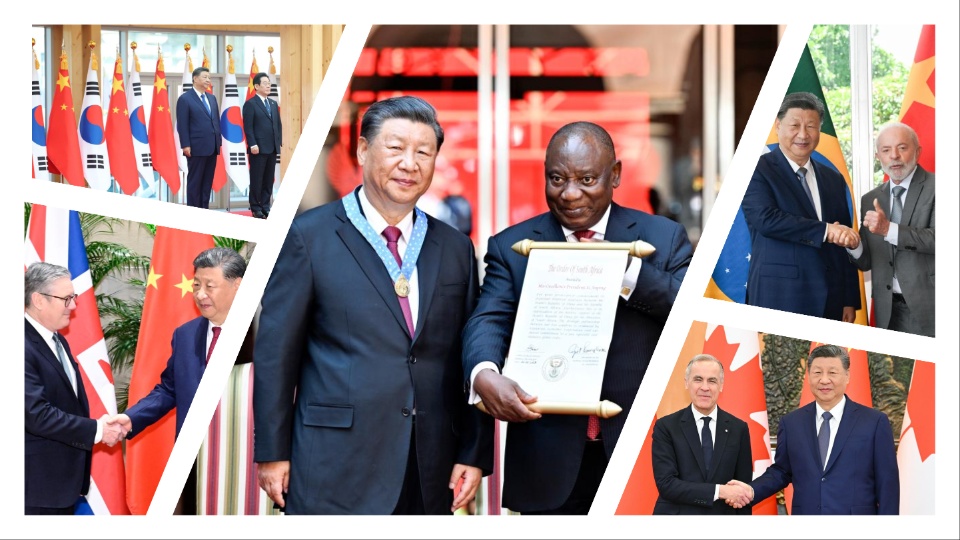
President Donald Trump’s aggressive posture and volatile trade attacks are affecting international views of the U.S. and making China seem the more reliable partner. Many countries are looking to strengthen their ties to China. President Xi Jinping is seen in this set of photos with several world leaders, from left: South Korean President Lee Jae-myung, British Prime Minister Keir Starmer, South African President Cyril Ramaphosa, Brazilian President Lula da Silva, and Canadian Prime Minister Mark Carney. | All photos via Xinhua News Agency
“Make China Great Again!”—a provocative headline from the European Council on Foreign Relations (ECFR) encapsulates the shifting global dynamics under President Donald Trump. This analysis, presented in a survey conducted across 21 countries in November 2025, reveals a curious trend: While Trump’s second term has seemingly diminished America’s stature globally, it has inadvertently elevated China’s image as a stable partner.
The ECFR’s assessment is not merely a tongue-in-cheek jab at the former president; it highlights a critical observation. The survey indicates a significant decline in the perception of the U.S. as a shared-value ally, contrasted by an uptick in favorable views of China. For instance, Brazil saw a drop of U.S. approval from 29% to 26%, while China’s favor rose from 24% to 27%. In South Africa, favorable perceptions of the U.S. fell from 23% to 19%, while China’s approval increased from 34% to 37%.
This increasing trend has not gone unnoticed. Respondents across various nations expressed a belief that China’s influence would grow in the coming decade. The data suggests a paradigm shift where countries traditionally aligned with the U.S. are beginning to reassess their diplomatic strategies, opting for more robust ties with Beijing. This is particularly evident in nations like India, where favorable opinions of China almost doubled, jumping from 11% to 22%.
Trump’s aggressive “America First” agenda, including controversial foreign interventions and trade tariffs, appears to have acted as a catalyst for this realignment. As the ECFR points out, the U.S.’s erratic foreign policy under Trump has not only alienated allies but also encouraged nations to consider strengthening their relations with China. The situation in Venezuela, exacerbated by U.S. military actions, only served to reinforce this trend.
The survey results reveal a broader narrative: as the “predatory” aspects of U.S. foreign policy come into view, nations that once upheld America as a stable ally are now seeking partnerships with China. The ECFR concludes that the world seems more receptive to Chinese influence while viewing U.S. actions with skepticism. Countries previously apprehensive about aligning with China are now exploring ties, viewing it as a counterbalance to U.S. unpredictability.
Take Canada, for example. Prime Minister Mark Carney’s recent visit to Beijing culminated in the announcement of a “new strategic partnership” focused on trade and investment. This included a dramatic reduction in tariffs on Chinese electric vehicles—a move that contrasts starkly with U.S. attempts to isolate China economically. Canada aims not just to revitalize its automotive sector but also invites Chinese investment in critical infrastructure sectors like renewable energy.
This Canadian pivot mirrors a broader trend. Leaders from various nations are descending on Beijing to negotiate new frameworks of cooperation. South Korean President Lee Jae-myung’s recent visit and UK Prime Minister Keir Starmer’s planned trip further illustrate this shift in diplomatic engagement. High-level meetings, which were once avenues for discussing grievances, are now becoming forums to bolster partnerships with China.
Political analysts point out that this shift stems from a growing realization: the U.S. is seen as a less reliable partner. As quoted in Bloomberg, political scientist Alexander Dukalskis noted, “When your enemy is busy hurting itself, just sit back and enjoy the show.” This sentiment encapsulates a nuanced viewpoint emerging globally—nations are not merely responding to American actions, they are actively recalibrating their foreign policies in light of a changing geopolitical landscape.
We hope you appreciated this article. At People’s World, we believe news and information should be free and accessible to all, but we need your help. Our journalism is free of corporate influence and paywalls because we are totally reader-supported. Only you, our readers and supporters, make this possible. If you enjoy reading People’s World and the stories we bring you, please support our work by donating or becoming a monthly sustainer today. Thank you!
CONTRIBUTOR